
We're Looking for People
Who Take Their Craft Seriously.
About the Work
This Is a Real Studio.
Treat It Like One.
🎯 Deliver what you agree to.
Scope is defined upfront. Deadlines are real. We work around life — but we don’t work around people who don’t show up.
🔀 Use Git. No exceptions.
All work is submitted via Git (GitHub or GitLab). If you haven’t used Git before, that’s fine — we’ll get you set up. But it’s not optional.
💬 Communicate early.
If you’re stuck, behind, or need to renegotiate scope — tell us before the deadline, not after. Early communication fixes almost everything.
Benefits
What Helen Game Factory Provides
Formal Certificate
Published Game Credit
Unity Mentoring
Remote & Flexible
Current Openings
Open Volunteer Positions
Programming · Remote · Volunteer
C# Programmer
We need a C# developer who can write clean, maintainable code and work within a Unity project without needing hand-holding. You’ll be implementing gameplay systems, tools, or features — depending on the project. The code you write goes into a real shipped game, so we care about quality.
If you have a game development background: Show us something you’ve built. A GitHub repo, a playable demo, a published game — anything that demonstrates you can implement game systems in code. We’ll assess your work honestly and tell you whether it’s a fit.
If you come from a non-game background: That’s fine. C# developers from enterprise, web, or application backgrounds often transfer very well into Unity. We’ll run you through how Unity’s component system works, how MonoBehaviour differs from standard C# classes, and how game loops are structured. Your existing knowledge in OOP, design patterns, and clean code is genuinely valuable — you just need the Unity-specific layer on top.
✦ Gameplay mechanics — movement, interaction, physics
✦ UI systems — menus, HUD, inventory screens
✦ Game state management — save/load, scene transitions
✦ Event systems and game architecture
✦ Performance-aware code — no memory leaks, no Update() bloat
✓ Strong C# fundamentals
✓ OOP — classes, interfaces, inheritance
✓ Git — push, pull, branch, merge
✓ Ability to read and write clean code
✓ Self-directed — can work from a brief
◈ Unity experience (any level)
◈ Design patterns — Singleton, Observer, FSM
◈ Mobile development experience
◈ Knowledge of Unity’s Input System
◈ Experience with ScriptableObjects
If you have game dev experience: A GitHub link or playable demo is required with your application. We won’t review applications without one.
If you don’t: Submit a sample of your C# code from any context — an application, a utility, a tool. Show us how you think in code.
2D Art & Design · Remote · Volunteer
2D Graphic Designer & Artist
We need a 2D artist who can create game-ready assets that work inside Unity. This covers UI elements, character sprites, icons, textures, promotional artwork, and anything else a 2D pipeline might require depending on the project.
If you have a game art background: Show us what you’ve made for games specifically — sprite sheets, UI kits, in-game assets. We want to see work that’s been built for real-time use, not just portfolio illustrations.
If you come from graphic design, illustration, or motion design: Your visual skills transfer directly. We’ll walk you through how Unity imports and uses 2D assets — atlas packing, sprite slicing, the Canvas system, and asset resolution for mobile. If you can design cleanly in Photoshop, Illustrator, or Affinity, you already have most of what you need.
✦ UI elements — buttons, panels, icons, HUD components
✦ Character and NPC sprite sheets
✦ Background and environment art
✦ Game logo and promotional artwork
✦ Store listing assets — icon, feature graphic, screenshots
✓ Proficiency in at least one of:
Photoshop · Illustrator · Affinity Designer · Procreate
✓ Ability to export assets in correct formats (PNG, SVG)
✓ Understanding of resolution and screen density
✓ Git — for asset delivery and version control
✓ Takes design briefs seriously and delivers on scope
◈ Experience creating game UI or sprite sheets
◈ Knowledge of Unity’s Canvas and Image components
◈ Animation — sprite animation or After Effects
◈ Understanding of mobile screen safe areas
◈ Experience with asset atlases
3D Art · Remote · Volunteer
3D Artist & Modeller
We need a 3D artist who can create low-poly, game-ready 3D assets for use in Unity. This is mobile game development — performance matters. Assets need to be optimised, correctly UV-mapped, and exported cleanly for real-time use. We work primarily in Blender, but any 3D software that exports FBX or OBJ is acceptable.
If you have a game art background: Show us in-game 3D assets — models that went into a real-time environment. We want to see your polycount discipline, your UV maps, and how your models behave inside a game engine.
If you come from product design, architecture, animation, or VFX: High-poly and render-focused 3D work translates differently to game development — but the fundamentals of modelling, UVs, and materials are the same. We’ll walk you through low-poly optimisation, texture baking for mobile, and the Unity FBX pipeline. If you understand topology, you can make the switch.
✦ Environment props — furniture, objects, architectural elements
✦ Character models (low-poly, mobile-optimised)
✦ Textures — PBR materials, baked lightmaps
✦ Rigged assets for animation (where required)
✦ Collision meshes and LOD variants
✓ Proficiency in Blender (preferred) or any 3D DCC tool
✓ Ability to UV unwrap and texture assets
✓ Understanding of polycount and mobile optimisation
✓ FBX or OBJ export for Unity
✓ Git — for asset delivery
✓ Can work from a brief with reference images
◈ Blender specifically — Bahman can support you directly
◈ Experience with PBR texturing (Roughness/Metallic workflow)
◈ Texture baking experience
◈ Rigging and weight painting
◈ Unity material and shader setup
◈ Substance Painter or equivalent
Game background: Show us game-ready models — ideally with wireframe and in-engine screenshots. We want to see polycount discipline and how your work performs in a real-time environment.
Non-game background: Show us your modelling work regardless of context. If you have renders, show renders. Then tell us about your willingness to adapt to game constraints — we’ll assess the rest.
Level Design · Remote · Volunteer
Level Designer
Level design is where the game actually happens. We need someone who understands space, pacing, player psychology, and puzzle flow — and can translate that understanding into Unity scenes. This role requires both creative vision and practical execution.
If you have game design or level design experience: Show us levels you’ve designed — in any engine. Screenshots, a playable build, a design document. We want to see evidence that you think about player experience, not just visual layout.
If you come from architecture, interior design, UX design, or storytelling: Space design and user experience translate directly into level design. If you understand how people move through a space, how they discover information, and how tension is built — you already think like a level designer. We’ll teach you the Unity-specific tools.
✦ Designing and building game levels in Unity
✦ Puzzle layout and difficulty progression
✦ Player guidance — environmental storytelling and signposting
✦ Testing and iterating on level flow
✦ Working with the programmer to wire up interactive elements
✦ Documenting levels for the rest of the team
✓ Spatial thinking — ability to design engaging spaces
✓ Understanding of player psychology and pacing
✓ Ability to work in Unity (or willingness to learn quickly)
✓ Git — scenes and assets committed regularly
✓ Can communicate design decisions clearly in writing
✓ Plays games — you need to understand what makes them work
◈ Experience with Unity’s scene editor
◈ Knowledge of NavMesh and trigger zones
◈ Familiarity with greyboxing / blockout workflow
◈ Horror or puzzle game experience specifically
◈ Experience with ProBuilder or terrain tools
◈ Can write basic design documents
Game background: Show us game-ready models — ideally with wireframe and in-engine screenshots. We want to see polycount discipline and how your work performs in a real-time environment.
Non-game background: Show us your modelling work regardless of context. If you have renders, show renders. Then tell us about your willingness to adapt to game constraints — we’ll assess the rest.
Got Your Own Idea?
You Can Also Propose Your Own Game
Volunteers don’t have to join an existing project. If you have a game concept you want to build — and the skills to contribute to it — you can propose it to Helen Game Factory. If we see potential in the idea, we’ll bring it into the studio, support its development, and publish it under our account.
The same revenue sharing arrangement applies. And if your game is genuinely excellent, we may discuss a wholesale purchase.
We Use Git. Full Stop.
All work at Helen Game Factory — code, art assets, level files, documentation — is submitted through Git. This is non-negotiable. Git is how we track versions, review contributions, avoid conflicts, and maintain the integrity of the project over time.
If you haven’t used Git before, that’s fine. We’ll set you up with a repository, show you the basic workflow — clone, branch, commit, push, pull request — and get you comfortable with it before your first milestone. It takes an afternoon to learn the basics. After that it becomes second nature.
What we won’t do is accept work sent over email, Google Drive, or WhatsApp. If it’s not in the repo, it doesn’t exist.
Branch for every task
Every piece of work gets its own branch. No committing directly to main. We review and merge. This keeps the project clean.
Meaningful commit messages
Write commit messages that say what changed and why. Not “fix” or “update”. Something a teammate can read in six months and understand.
Push on milestone dates
Your agreed deliverable dates are the dates your work is in the repo — not the date you start uploading. Plan accordingly.
GitHub or GitLab — your choice. We’ll share the repo link once you’re onboarded.
On Completion
Your Formal Certificate
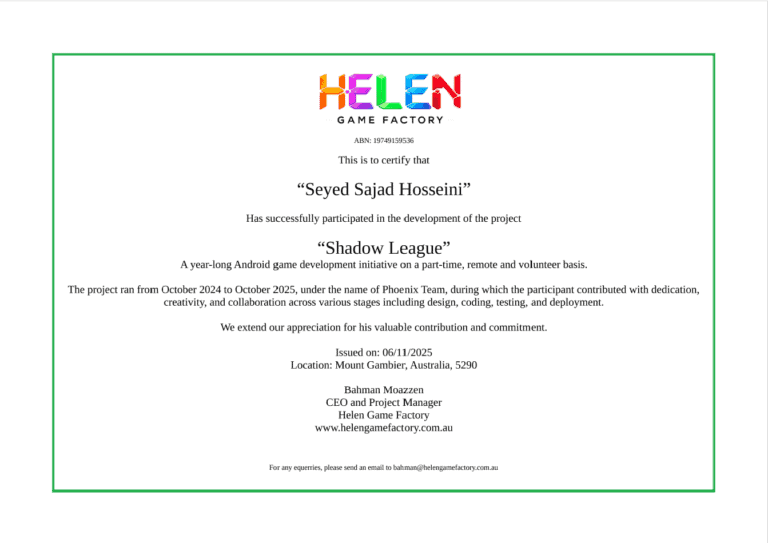
Every contributor who completes their agreed scope of work receives a formal certificate of participation from Helen Game Factory. This is not a generic template with your name pasted in. It is a properly formatted PDF document that includes everything a future employer, client, or collaborator would want to see.
✦ Your full name and role title
✦ The game project you contributed to
✦ A description of your specific contribution
✦ Your contribution period — start and end dates
✦ Issued by Helen Game Factory
✦ Helen Game Factory ABN number
✦ Digitally signed by the studio director
✦ Delivered by email as a PDF
The certificate is issued only on completion of the agreed scope. Partial contributions may be recognised at the studio’s discretion. If you need to step away before finishing, let us know early — we can discuss what’s achievable.
Apply Now
Submit Your Application
Read the role requirements carefully before applying. Tell us which role you want, send us your work sample, and write a short cover letter. We review every application and respond within 5 business days.
What Happens After You Apply
01 · We review your application
Within 5 business days
02 · We look at your work sample
Honestly and thoroughly
03 · We get back to you
Accept, decline (with feedback),
or ask follow-up questions
04 · Short online conversation
To discuss the project,
scope, and expectations
05 · Scope agreed in writing
Milestones, deadlines,
and deliverables confirmed
06 · You’re onboarded
Repo access, brief provided,
and work begins
We respond to every application. If we pass, we tell you why — and what would make your application stronger in future.
Ready to Work on Something Real?
Helen Game Factory is looking for contributors who are serious about their craft and want their work to actually ship. If that’s you — we want to hear from you.